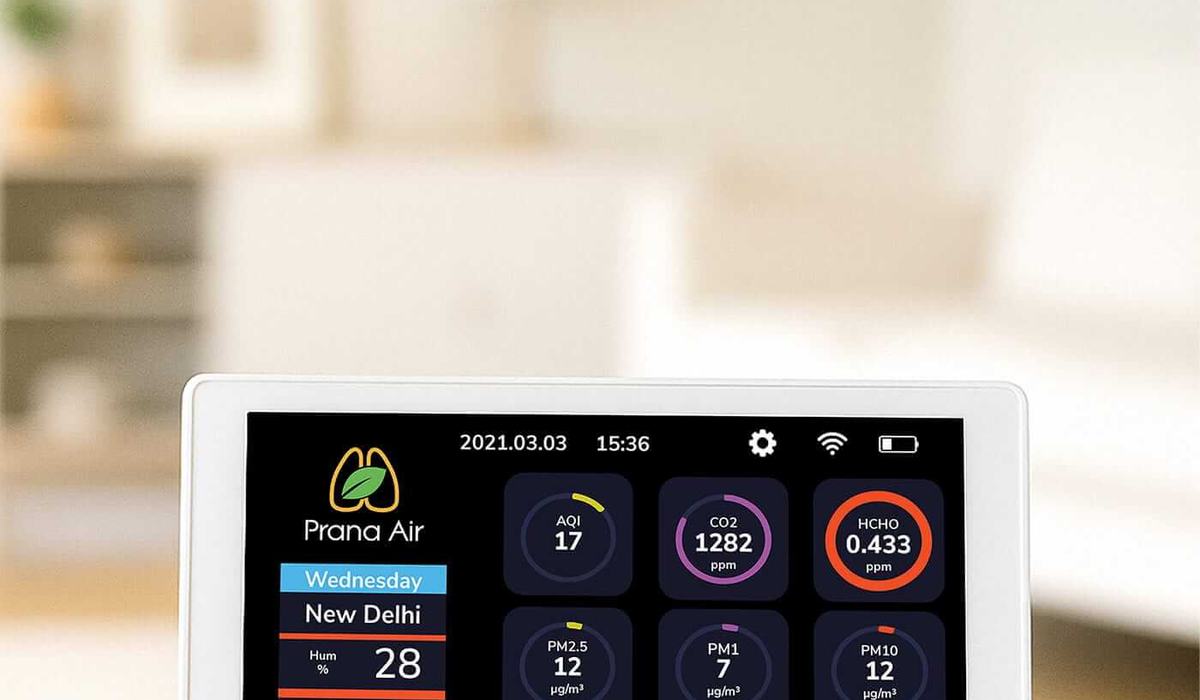
The appeal of an air quality monitor is obvious: a number on a screen telling you whether your air is fine. The reality is that monitors are useful only if you know which readings matter and what to do about each. Otherwise you get an anxiety device that flashes orange during cooking and tells you nothing actionable.
Used well, though, a monitor is the highest-value $40 you can spend on apartment air, because it stops you buying a purifier to solve a ventilation problem or a dehumidifier to solve a dust problem.
- Worth it if: you are about to spend $150+ on any air device and do not know which one you need.
- Not worth it if: you already know your problem — buy the fix instead.
- Four readings matter: PM2.5, CO2, humidity, and temperature (for the first three to mean anything).
- Ignore: a single aggregate “air quality score”. It hides which pollutant is the problem.
On this page
What a monitor actually measures
Consumer monitors use small sensors. Each has different accuracy, and knowing the limits stops you over-reacting.
| Sensor | Measures | Accuracy reality | Cost |
|---|---|---|---|
| Laser particle counter | PM1 / PM2.5 / PM10 | Good — reliable for trends | $25–$80 |
| NDIR CO2 | Carbon dioxide (ppm) | Good — the most trustworthy cheap sensor | $20–$50 |
| Capacitive humidity | Relative humidity | Good — within 3–5% | $5 |
| TVOC (metal-oxide) | Total volatile organics | Poor — trends only, not absolute values | $10–$25 |
| Formaldehyde | HCHO | Weak on cheap units; use as a flag only | $20–$80 |
A $40 monitor will not give you a laboratory-accurate PM2.5 figure. It will reliably show you that cooking pushes the reading from 8 to 180, that windows shut overnight raises CO2 past 1,500, and that a purifier brings PM2.5 back down fast. Trends are what drive decisions.
The four readings that matter in an apartment
| Reading | Good | Act at | What it means |
|---|---|---|---|
| PM2.5 | under 12 µg/m³ | 35 µg/m³ | Particles: smoke, dust, cooking. Filtration fixes this. |
| CO2 | under 800 ppm | 1,200 ppm | Stale air. Ventilation fixes this — filters cannot. |
| Humidity | 30–50% | over 60% / under 30% | Mould risk or dryness. Dehumidifier or humidifier. |
| Temperature | 18–24°C | — | Needed for humidity to be meaningful, and for comfort. |
Why CO2 is the reading people underrate. It is the best proxy you have for ventilation. A bedroom with the door closed and the window shut climbs past 1,500 ppm most nights, and that correlates directly with the stuffy, heavy feeling and the morning headache that people blame on poor sleep.
How to run a useful test
- Position it right. Sitting height on a side table, away from the kitchen, away from a radiator, away from the purifier outlet.
- Log three moments. Morning with windows shut; 30 minutes after cooking; one hour after opening windows.
- Run one controlled experiment. Cook onions with the monitor nearby, then run the exhaust fan for 20 minutes and watch how fast PM2.5 falls.
- Repeat on a different day. One day is noise; three days is a pattern.
- Write down the two worst readings. Those are your actual problems — ignore everything else.
“PM2.5 peaks at 180 during cooking and returns to 10 after 20 minutes with the fan on. CO2 hits 1,600 overnight with the door shut. Humidity is fine.” That tells you: ventilation habits first, a bedroom purifier second, no dehumidifier needed. That is $40 well spent.
How much to spend
| Price band | What you get | Who it is for |
|---|---|---|
| $25–$45 | PM2.5 + CO2 + humidity, no logging | Most apartment renters — the sweet spot |
| $50–$90 | Adds VOC/formaldehyde flags, WiFi, app history | Data lovers who want overnight graphs |
| $120–$250 | Better sensors, calibration, multi-room logging | Allergy or asthma households, or multi-room use |
If you are buying to make one decision — purifier or not — the $25–$45 band is enough. Spend more only if you intend to track overnight patterns, which is genuinely useful when you are chasing sleep-related air problems.
What to do with each reading
| If you see… | The fix | Not the fix |
|---|---|---|
| PM2.5 high, CO2 normal | HEPA purifier sized correctly | Opening windows (helps little) |
| CO2 high, PM2.5 normal | Ventilation: exhaust fan, window crack | Any purifier — it cannot remove CO2 |
| Humidity over 60% | Dehumidifier, squeegee, dry laundry outdoors | Purifier |
| Humidity under 30% | Evaporative humidifier to 40–45% | Purifier |
| VOC flag high, PM2.5 normal | Ventilate, remove the source, carbon filter | HEPA alone |
The point of measuring is to buy less, not more. Plenty of apartments need no purifier at all — just a fan habit and a door seal. If your readings come back clean, treat that as a result, not a gap in your gadget collection.
A $40 monitor that reads PM2.5, CO2 and humidity pays for itself by preventing one wrong purchase. Run the three-moment test over three days, write down your two worst readings, and fix those two things. Ignore the aggregate score.
Frequently asked questions
What the numbers actually mean
| Metric | Good | Concerning | Source |
|---|---|---|---|
| PM2.5 | Under 12 µg/m³ | Over 35 µg/m³ | Cooking, smoke, traffic |
| CO2 | Under 1,000 ppm | Over 1,500 ppm | Exhaled air, poor ventilation |
| TVOC | Under 0.5 mg/m³ | Over 1 mg/m³ | Paint, furniture, cleaners |
| Humidity | 40–50% | Over 60% | Damp, drying laundry |
| Formaldehyde | Under 0.08 ppm | Over 0.1 ppm | New furniture, MDF |
A monitor is diagnostic rather than protective — it does not clean the air, it tells you which problem you have. That is genuinely useful in an apartment, where the same symptom (stuffy air) can come from excess CO2, cooking particles, a damp patch or off-gassing from new furniture, and each requires a completely different fix.
CO2 is not usually a health hazard at domestic levels, but it is the most reliable indicator of ventilation. If it climbs past 1,500 ppm in a bedroom overnight, you are rebreathing stale air, and opening a window will do more for how you feel than any purifier.