A refrigerator door hangs on hinges and is pulled shut by a closer. Over years of use, the hinge pins wear, the bushings oval, and the door begins to drop — often imperceptibly at first, then enough that the gasket no longer meets the cabinet squarely.
This matters because a sagging door produces exactly the same symptom as a failed gasket: poor sealing, a compressor that runs long, and warm food. Replacing the gasket without addressing the hinge wastes the part.
- Look at the door gap top and bottom — is it even?
- Check the level of the whole refrigerator; it should lean slightly back.
- Lift the door gently at the handle — any vertical play means hinge wear.
- Run the banknote seal test at the top and bottom corners.
- Check for rubbing where the door meets the cabinet.
- Only then decide between adjustment and replacement.
On this page
Why doors sag
- Hinge pin wear — metal on plastic or metal on metal, wearing over years.
- Bushing failure — the nylon or bronze bushings oval under load.
- Overloaded door shelves — gallon jugs in the door put a turning moment on the hinge.
- Loose hinge screws — the simplest cause and the easiest to fix.
- A cabinet that is not level, so the door hangs against gravity.
- Repeated door slamming, which is cumulative.
What you can adjust
- Level the refrigerator first. Most have levelling feet at the front; raise the front slightly so the door self-closes.
- Tighten the hinge screws. Access is usually under a plastic cap at the top and bottom of the door frame.
- Adjust the top hinge shims if your model has them, to square the door in the opening.
- Check the door stop if the door swings past 90 degrees and hits the cabinet.
- Re-run the banknote test after each adjustment.
- Re-hang the door squarely if the adjustment range is exhausted — this often restores the seal.
Many 'sagging' refrigerator doors are simply a fridge that is not level, or one leaning forward. Modern fridges close using gravity as well as the gasket magnet, so a slightly raised front makes the door pull itself shut. Check the level first — it costs nothing.
Replacing the hinge
- Order the exact hinge and bushing set for your model, and buy both top and bottom if they are worn.
- Empty the door shelves completely, and ideally the whole fridge.
- Unplug the refrigerator.
- Get help. A loaded fridge door is heavy and awkward; this is not a one-person job on a large model.
- Support the door before removing the top hinge.
- Remove the hinge cover, then the hinge bolts, and lift the door off the bottom pin.
- Inspect the bushings in the door and the cabinet — replace them with the hinge.
- Fit the new bottom hinge and bushings, then set the door on the pin.
- Fit the top hinge loosely, square the door, then tighten.
- Check alignment and run the banknote test around the frame.
- Transfer or refit the door's electrical connector if it has a water or ice dispenser.
If the door will not drop onto the pin cleanly, the hinge is not square. Forcing it damages the bushing and the cabinet mounting, turning a simple repair into a structural one. Align first, then lower.
The door closer and cams
Many refrigerators use a cam-based closer: a shaped cam and follower that pulls the door shut over the last few centimetres and holds it closed. When the cam wears, the door stops self-closing and drifts open.
- Symptoms: the door needs a push to close, or drifts ajar on its own.
- The cam is usually a plastic or nylon part at the hinge; the follower is spring-loaded.
- Worn cams are inexpensive and straightforward to replace alongside the hinge.
- A weak spring can sometimes be replaced separately.
- Check the cam before condemning the hinge — it is often the actual fault.
- Fit a new cam and follower together, since they wear as a pair.
After the repair
- Run the banknote test at six points; it should grip firmly all round.
- Confirm the door self-closes from a partly-open position.
- Check the door does not rub the cabinet at any point through its swing.
- Give it 24 hours and verify compartment temperature with a thermometer.
- Re-check the hinge screws after a week, since new joints settle.
- If the fridge still runs long, the gasket may also need replacing — hinge wear and gasket wear often arrive together.
Preventing it happening again
- Keep heavy items off the door shelves — milk and large bottles go on the main shelves.
- Keep the fridge level, with the front slightly raised.
- Do not slam the door or use it to push the fridge closed.
- Do not use the door as a lever when moving the appliance.
- Check the hinge screws once a year.
- Replace bushings with the hinge rather than reusing worn ones.
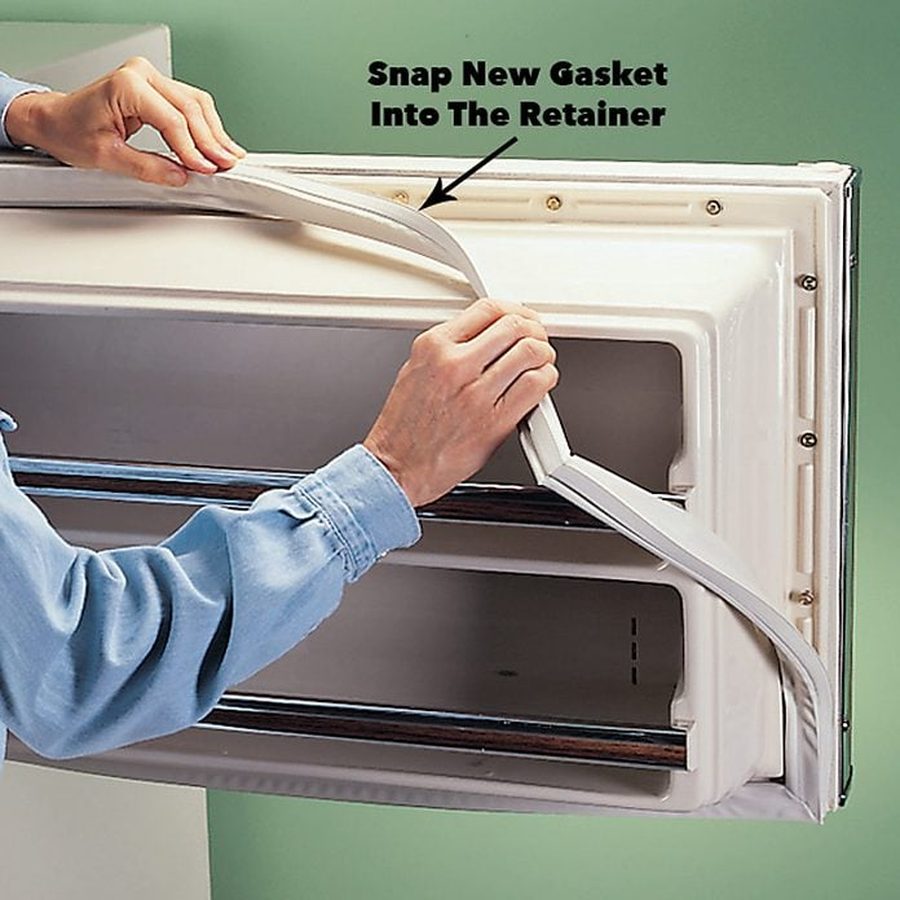
Door hinge and bushing kit — buy for your model
Replace the hinge and bushings together, and check the closer cam while you have the door off. A new gasket alone will not fix a sagging door.
Check Price on Amazon →Check the gasket while the door is off
Hinge wear and gasket wear usually arrive together. With the door already off, inspect the gasket and replace it if it has hardened or cracked.
Check Price on Amazon →Check the level and the screws before assuming a worn hinge. If there is vertical play in the door, replace the hinge and its bushings together, and inspect the closer cam. A sagging door will defeat a brand-new gasket, so fix the hinge first.
Frequently asked questions
Two-person job, and why
| Stage | Why help is needed |
|---|---|
| Supporting the door | A loaded door weighs 20–40 kg |
| Lifting off the bottom pin | Off-centre weight, awkward grip |
| Aligning the top hinge | Door must be held square while bolts go in |
| Refitting the dispenser connector | Door must be held at the right height |
| Checking alignment | Someone has to watch the gap |
A refrigerator door looks light until you take it off its hinges. With shelves and a dispenser assembly, a full-size door is a two-person lift, and it is off-centre — the mass sits at the front edge, away from the hinge, which is exactly where your grip is weakest.
The practical approach is to empty the door completely first, which removes 5–10 kg, and then to have a second person support the door while you release and refit the hinge. Trying to do it alone risks dropping the door, damaging the hinge mounting in the cabinet, and then having a repair that costs more than the fridge is worth.