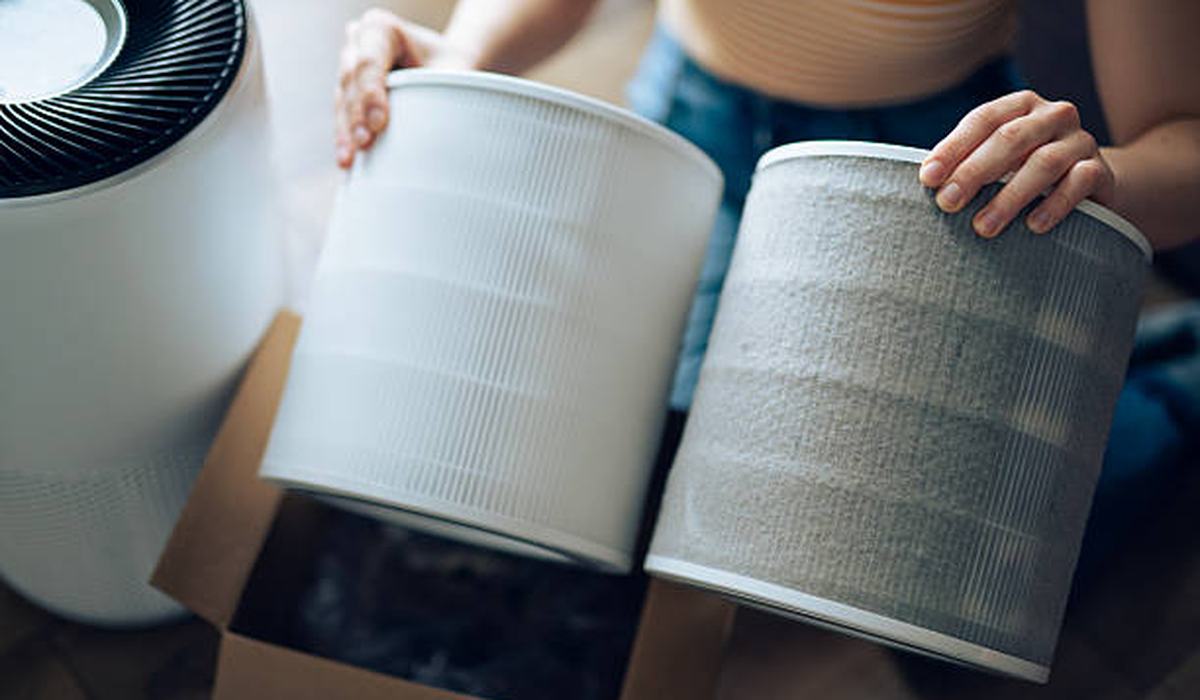
An air purifier is only as good as its filter. Once the filter loads up, airflow falls, the fan has to work harder, and the unit quietly stops cleaning the air — while still running and still sounding as though it is doing something.
The complication is that a typical purifier has two or three filter stages with different lives. Knowing which to change, when, and how to reset the unit is what keeps it effective.
| Filter stage | Typical life | Cleanable? |
|---|---|---|
| Pre-filter | 1–3 months | Yes — vacuum or rinse |
| HEPA filter | 6–12 months | No — replace |
| Activated carbon | 3–6 months | No — replace |
| Combined HEPA/carbon | 6–12 months | No — replace |
| Ionizer / washable plate | Monthly | Yes — wash and dry |
Pre-filled units sold as a single cartridge change everything at once; the schedule above applies where the stages are separate.
On this page
Signs the filter is done
- Noticeably reduced airflow from the outlet — the single most reliable indicator.
- More noise at the same speed setting, as the fan strains against a loaded filter.
- Visible grey or brown discolouration across the filter face.
- Dust settling again on surfaces within a day or two of cleaning.
- Odours lingering — the carbon layer is exhausted.
- Allergies returning indoors while the unit runs continuously.
- A filter indicator light — useful, but usually a timer rather than a real sensor.
Filter stages explained
| Stage | What it removes | Why it matters |
|---|---|---|
| Pre-filter | Hair, dust, lint, pet fur | Protects the HEPA layer and extends its life |
| HEPA | Particles 0.3 microns and above — pollen, smoke, PM2.5 | The main cleaning stage |
| Activated carbon | Odours, VOCs, cooking smells | Does not remove particles |
| Antibacterial layer | Reduces microbes on the filter itself | Secondary |
| Ionizer | Charges particles for capture | Optional; some produce ozone |
'HEPA-type', 'HEPA-like' and '99% efficiency' are marketing terms. A genuine HEPA filter captures 99.97% of particles at 0.3 microns, and the specification is printed on the filter or the box. When buying replacements, match the original specification rather than the price.
When to change each
| Stage | Interval | Household adjustments |
|---|---|---|
| Pre-filter | Every 1–3 months, cleaned monthly | Weekly vacuuming if you have pets |
| HEPA | Every 6–12 months | Every 6 months with pets, allergies or wildfire smoke |
| Carbon | Every 3–6 months | Sooner in a kitchen-adjacent room or with smokers |
| Combined cartridge | Every 6–12 months | Sooner with heavy use |
| Washable plate | Monthly wash | Always dry fully before refitting |
Two factors compress every interval: pets and outdoor smoke. A household with a shedding dog, or one running a purifier through a wildfire season, will exhaust a HEPA filter in half the normal time.
Replacing a filter
- Unplug the purifier.
- Note the airflow direction arrow on the old filter — the new one goes in the same way.
- Remove the access panel or lift the top assembly, depending on model.
- Photograph the filter arrangement if there is more than one stage.
- Pull the old filter out and dispose of it in a bag; it will be full of fine dust.
- Vacuum the housing interior before fitting the new filter, and wipe it with a dry cloth.
- Fit the new filter in the correct orientation, matching the arrow.
- Refit the panel and make sure it seats fully, or the unit will leak air around the filter.
- Reset the filter indicator as described below.
- Run on high for ten minutes to confirm airflow and check for rattles.
Vacuuming a HEPA filter damages its fibres and releases captured particles back into the room. Vacuuming is for the pre-filter only. When the HEPA layer is loaded, replace it — that is what it is designed for.
Resetting the unit
- Locate the reset button — often recessed, near the display or under the top cover.
- Press and hold for three to five seconds, or as the manual specifies.
- Some models reset via the app, under filter settings.
- Some units require the panel to be opened and closed after a filter change; the light clears automatically.
- If the light will not clear, check the manual — a few models use a specific button combination.
- Log the date so the next change is timed from reality rather than the light.
OEM vs aftermarket filters
| Consideration | OEM filter | Aftermarket filter |
|---|---|---|
| Fit | Guaranteed | Variable; check dimensions carefully |
| Filtration spec | As designed | Often lower, sometimes much lower |
| Airflow restriction | Matched to the fan | Can be higher, reducing performance |
| Price | Higher | Lower |
| Warranty | Maintained | Can technically affect a warranty claim |
| Best for | Primary living space, allergies | Backup or low-use rooms |
Clean the pre-filter monthly, replace the HEPA layer every 6–12 months, replace carbon every 3–6 months, and reset the unit. Reduced airflow is your best signal. Buy filters matching the original HEPA specification rather than the cheapest listing.
Frequently asked questions
Filter cost over five years
| Approach | Per year | Five years |
|---|---|---|
| OEM HEPA + carbon, 2 changes a year | $70–$120 | $350–$600 |
| OEM HEPA yearly + carbon twice | $60–$100 | $300–$500 |
| Aftermarket, 2 changes a year | $35–$60 | $175–$300 |
| Washable pre-filter plus HEPA yearly | $45–$80 | $225–$400 |
| Under-sink filter system instead | $40–$80 | $200–$400 |
Filter cost is the real running cost of an air purifier, and it usually exceeds the purchase price within three years. That changes the buying decision: a machine with cheaper, widely available filters is often the better long-term purchase than one with a lower sticker price and proprietary cartridges.
The way to control it is the pre-filter. A washable pre-filter that you vacuum monthly keeps hair and lint off the HEPA layer, and in a home with pets that alone can extend HEPA life from six months to a year.
Filter cost over a year
The purchase price of an air purifier is only part of what it costs to run one. Filters are a consumable, and the annual figure varies far more between models than the hardware price does, which makes filter cost the better long-term comparison.
| Filter type | Typical price | Replacement interval | Annual cost |
|---|---|---|---|
| Combined HEPA + carbon | $20–$45 | 6–12 months | $25–$90 |
| Separate HEPA | $18–$35 | 12 months | $18–$35 |
| Separate carbon | $10–$25 | 3–6 months | $20–$50 |
| Washable pre-filter | $8–$20 | Reusable | $0 after purchase |
A washable pre-filter is the single easiest way to cut running costs, because it removes the hair, dust and lint that would otherwise load the main filter first. Cleaning it monthly can meaningfully extend the life of everything behind it.
Before buying a purifier, price the replacement filters and check they are consistently stocked. A machine with cheap filters that are out of stock for months is more expensive than one with pricier filters you can actually buy.